
Climate Vulnerability and Political Participation in Bangladesh
Md. Siyam Hossain Shuvo, Md. Jahurul Islam & Shashi Shabnam Easha
July-Aug-Sep
Abstract
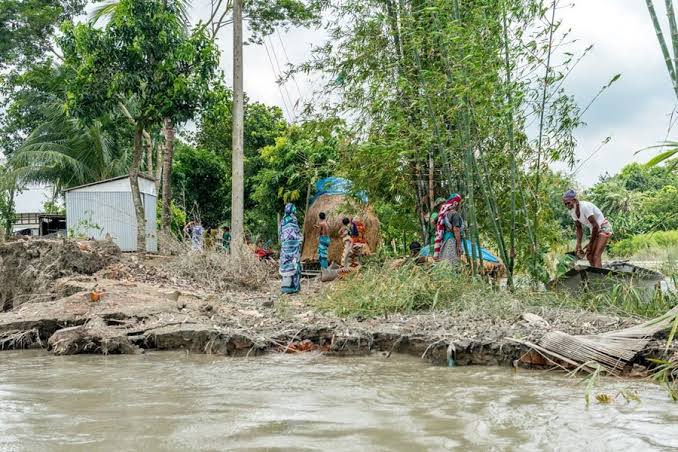
Escalating climate vulnerability due to recent unequivocal warming of the Earth has occupied pervasive scholarly and policy attention regarding disrupted livelihood adaptation and human security. Hence, the effects of displacement on political participation dynamics within a sovereign polity remain almost completely underexamined. This study employs densely populated Bangladesh, a low-lying deltaic topography with an agrarian economy, as a critical case to assess how chronic climate vulnerability conditions local political engagement. Combining insights from qualitative studies of climate vulnerability and political participation, with secondary disaster and displacement data and policy reports, this paper analyses four discrete yet interdependent cases (Remal, 2024): riverbank erosion and displacement, LoGIC and LAPA processes, and gender-responsive coastal adaptation to examine the mechanisms through which climate vulnerability affects political participation. Following a mechanism-focused research design, the cases analyse who is exposed to climate hazards, who is most sensitive, and finally, to what extent and under what criteria adaptation takes place. The results strikingly demonstrate that climate vulnerability neither uniformly suppresses nor automatically stimulates political engagement; rather, it creates two distinct paths of participation characterised by marginalisation or mobilisation, leaving scope for engagement as conditional citizenship or vice versa.
Keyword: Bangladesh; climate vulnerability; political participation; displacement; climate justice; NGOs; political ecology; democratic inclusion
Research Area: Political Science/Environment
Country: Bangladesh
download